Truth-Machine is interpretive infrastructure for institutional judgment.
Orientation
The architecture of Truth-Machine defines the structural conditions under which written material is interpreted, evaluated, and allowed to exert influence within a decision process.
Architecture precedes method. It does not determine outcomes or substitute for judgment. Instead, it enforces the interpretive discipline described in the Approach by constraining how meaning, evidence, and influence may interact before conclusions are formed.
Architectural Premise
Written material accumulates authority not only through individual claims, but through interaction over time—how assertions reinforce one another, how repetition amplifies confidence, and how structure guides interpretation.
Governance failures rarely originate in a single incorrect statement. They arise when interpretive signals propagate without constraint—when persuasive success, narrative momentum, or statistical regularity is allowed to masquerade as epistemic validity.
Truth-Machine is architected to address this structural risk directly. It does not decide what is true. It constrains how interpretive signals are admitted, combined, amplified, and stabilized so that authority is earned through evidence and disciplined reasoning rather than accumulated by form.
High-Level System Structure
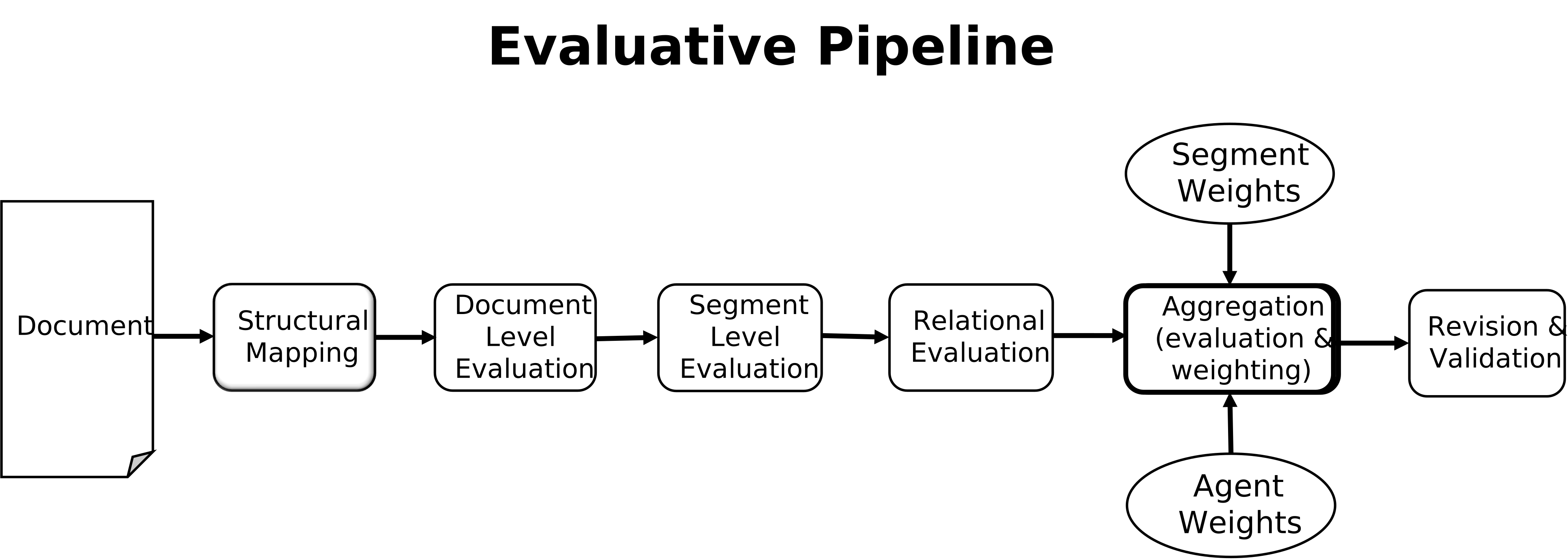
Truth-Machine operates as a staged interpretive pipeline. Each stage produces constrained outputs that serve as admissible inputs to subsequent stages.
No stage bypasses upstream constraints, and no downstream process retroactively overrides interpretive decisions made earlier. Governance is enforced structurally, not by post-hoc correction.
At a structural level, the system separates:
- interpretive decomposition from numerical evaluation,
- evaluation from weighting,
- weighting from aggregation,
- aggregation from amplification, and
- diagnostics from correction.
These separations are architectural commitments. They exist to prevent silent coupling between functions that, in ungoverned systems, tend to collapse into opaque or misleading outcomes.
Truth-Machine distinguishes between interpretive state and permitted transitions between stages. Governance parameters constrain how influence may couple locally and how it may persist or decay over time, ensuring stability without post-hoc adjustment.
Truth-Machine as Governed Signal Architecture
Truth-Machine can be understood as an interpretive integrated circuit: a governed environment in which signals are routed, coupled, damped, and permitted to persist only under explicit constraint.
Admissible interpretive signals may enter evaluation, but they do not propagate freely. Architectural governance determines:
- where influence may travel,
- how strongly signals may couple across criteria,
- when amplification is permitted or damped, and
- how persistence and decay operate over time.
The purpose is not to suppress interpretation, but to ensure that what accumulates into decision weight remains attributable, examinable, and evidentiary.
Truth-Machine does not suppress interpretation — it governs what is allowed to persist, couple, and accumulate into decision weight.
Evaluation, Weighting, and Aggregation (Clarifying Distinction)
Truth-Machine deliberately distinguishes three roles that are often conflated in analytic systems:
- Evaluation produces judgments about evidence, coherence, and interpretive signals.
- Weighting assigns relative importance to segments, criteria, or agents across time and scope.
- Aggregation combines completed evaluative and weighting outputs to produce relational views for diagnosis and review.
Aggregation does not generate new evaluative judgments. Its purpose is analytical, not decisive.
Put differently:
Aggregation is not where truth is decided.
Aggregation is where misalignment becomes visible.
By assembling evaluation and weighting results into explicit relational artifacts, the system enables reviewers to examine:
- where evaluative pressure accumulated,
- how weighting assumptions shaped outcomes, and
- which upstream stage most likely contributed to perceived misalignment.
Relational Review and Targeted Revision
Assembled outputs are subjected to relational review to assess alignment with document-scale intent and interpretive constraints.
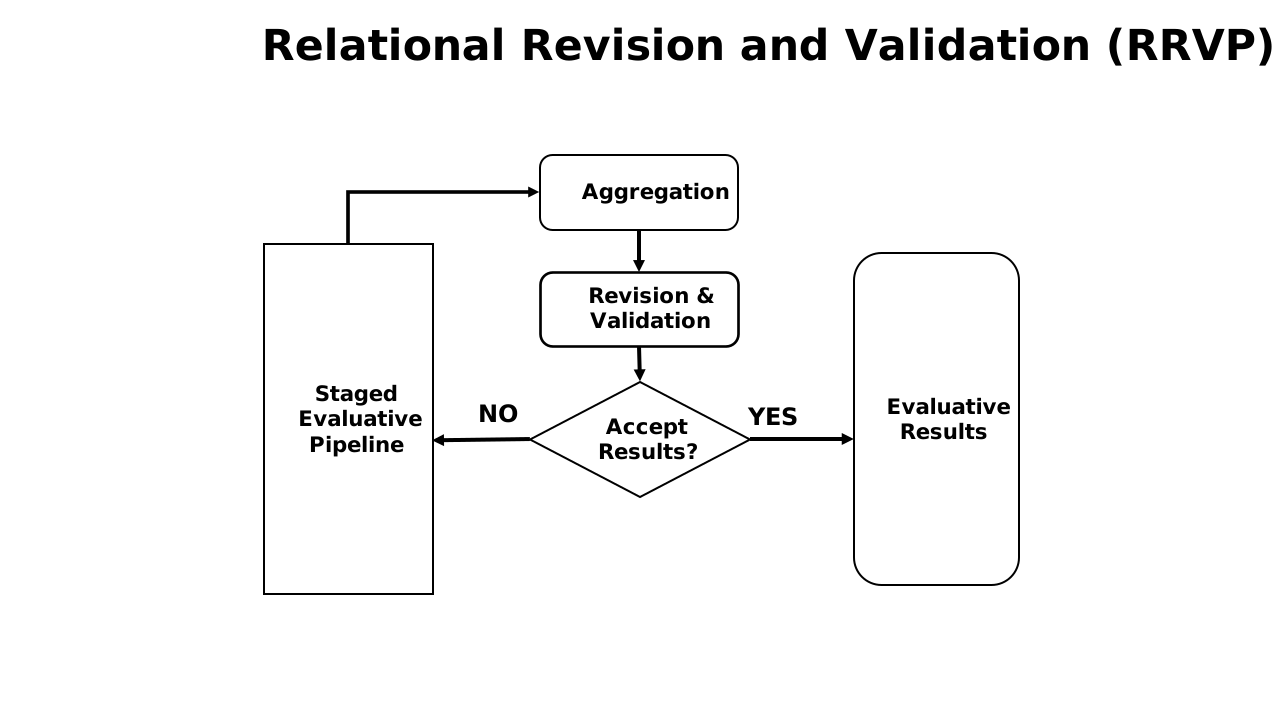
When misalignment is detected, Truth-Machine does not correct values or enforce convergence.
Instead, revision is routed to the appropriate upstream stage—interpretive decomposition, constraint definition, relational modeling, or weighting assumptions—where the source of misalignment can be examined directly.
This preserves interpretive integrity while enabling disciplined refinement.
Architectural Scope and Non-Goals
Truth-Machine is intentionally not optimized for speed, automation, or outcome generation. Its architecture prioritizes interpretive fidelity, constraint, and accountability over throughput.
It does not replace deliberation. It does not assert conclusions. It does not optimize for plausibility or consensus.
Human judgment remains the final authority. The architecture ensures that when judgment is exercised, the influences shaping it are visible, traceable, and open to scrutiny.
Architecture Summary
Truth-Machine’s architecture enforces interpretive governance by separating evaluation, weighting, aggregation, and revision into explicit structural roles.
By constraining how influence may propagate—and by using aggregation as a diagnostic lens rather than a decision mechanism—the system makes reasoning legible, revisable, and accountable where decisions carry real consequence.